Token spend is up. Every engineer has a coding agent. Yet tickets, reviews, and releases may still move at roughly the same pace. A high percentage of AI-written code tells you little about the work the team can actually ship.
Atomic Gravity works alongside engineering teams to build the environment that lets agents complete larger, bounded tasks at the quality your team expects.
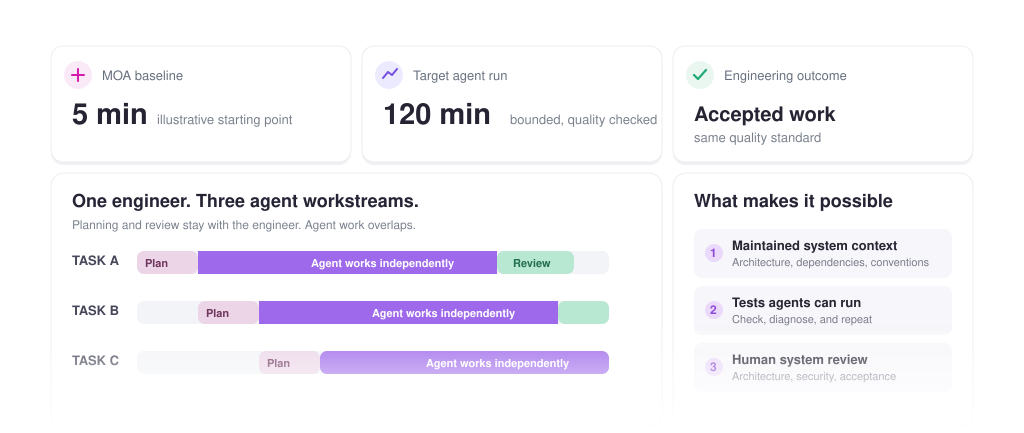
The goal: 2–4× more accepted work per engineer without lowering the quality bar.
An agent can generate a function quickly. Completing a ticket is harder when it has to rediscover the system, ask what “done” means, wait for someone to run tests, or guess whether the change works in a real environment.
In engineering teams we’ve observed, agents often make just two to five minutes of useful progress before an engineer needs to step in. Each interruption pulls an engineer back into the task, limiting how much work one person can direct—even when AI writes most of the code.
We measure that gap in Minutes of Autonomy (MOA): how long an agent makes useful progress on a defined task, at the quality you’d expect from an engineer, before an engineer needs to step in.
Extend agent autonomy.
Prove it.
We work alongside your engineers on a bounded part of your real codebase. The engagement starts with a number and ends with working infrastructure your team can keep using.
Tell us where your engineering team is using coding agents and where delivery still stalls. We’ll identify a useful place to establish your MOA baseline and discuss what it would take to increase it.